Is It Right for Me?
Artificial disc replacement is most commonly performed in the neck (cervical spine), as a surgical option for cervical disc herniation or degeneration that is causing arm pain from nerve compression, when non-surgical care hasn't been enough on its own. Rather than removing the damaged disc and fusing the two vertebrae into a single, fixed segment, the disc is replaced with a mobile implant that keeps that level of the neck moving.
The key difference from fusion is motion. Fusion stabilizes a level of the spine by locking it in place permanently. Disc replacement instead preserves motion at the treated segment, which may reduce the extra stress placed on the disc levels above and below it.
Whether disc replacement is the right choice depends on specifics that vary from patient to patient — the alignment of the neck, the quality of the bone, and the health of the facet joints at that level all factor in. Because of that, candidacy isn't something that can be determined from symptoms alone; it requires a review of your imaging.
The implant Dr. Gerlach uses: Mobi-C
For cervical disc replacement, Dr. Gerlach uses the Mobi-C Cervical Disc — the first artificial disc FDA-approved (2013) to treat both one and two levels of the cervical spine, with more than 225,000 implanted worldwide since 2004.
A mobile core that moves with you
Three pieces — two metal plates and a polyethylene insert whose patented mobile core can slide and rotate, self-adjusting so the segment moves like a natural neck.
Bone-sparing by design
No keels or screws — small teeth press into the vertebrae without cutting away bone, and a titanium/hydroxyapatite coating lets bone grow onto the plates for long-term stability.
Long-term evidence
Ten-year follow-up data show durable improvement in neck and arm pain — and in the two-level FDA study, results statistically superior to fusion at seven years.
Implant details and outcomes per the manufacturer’s published FDA study data (Mobi-C, Highridge Medical).
Motion Preservation vs. Fusion — see the difference
Both operations remove the worn disc and relieve the nerve. What happens to the segment afterward is where they part ways. Toggle to compare:
Choose an operation to compare
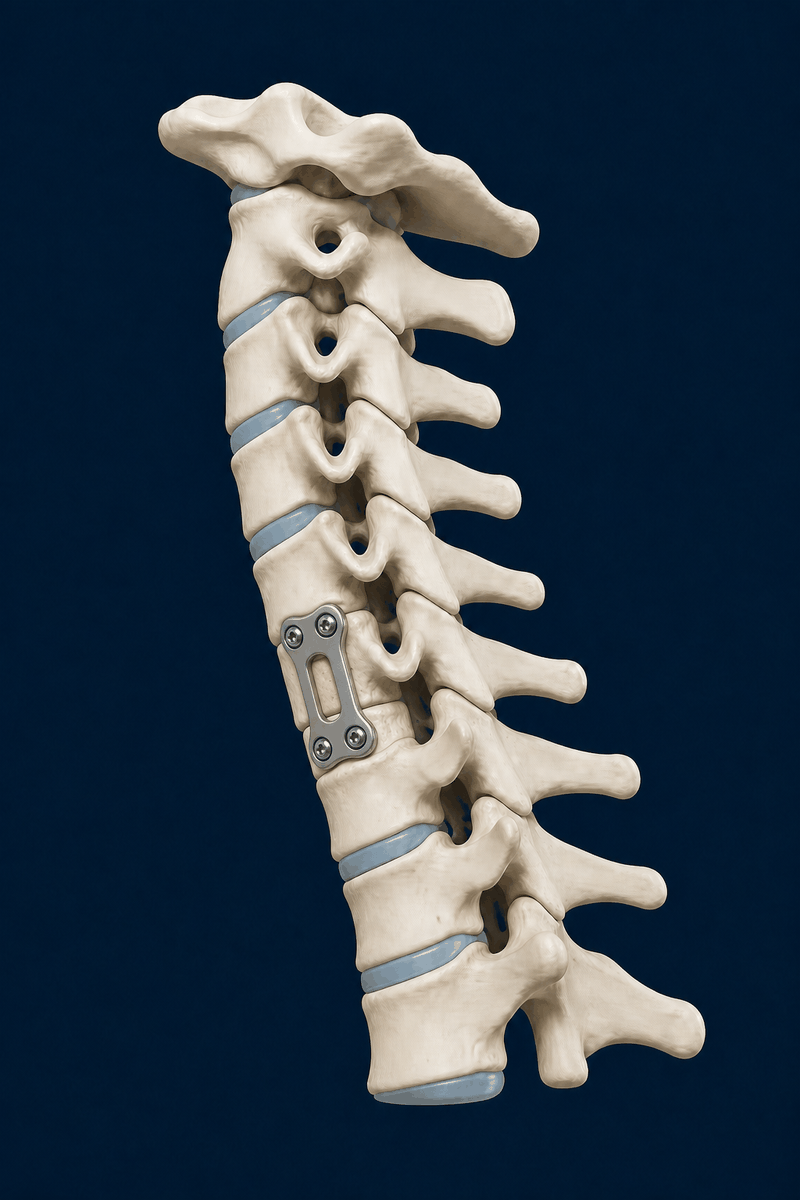
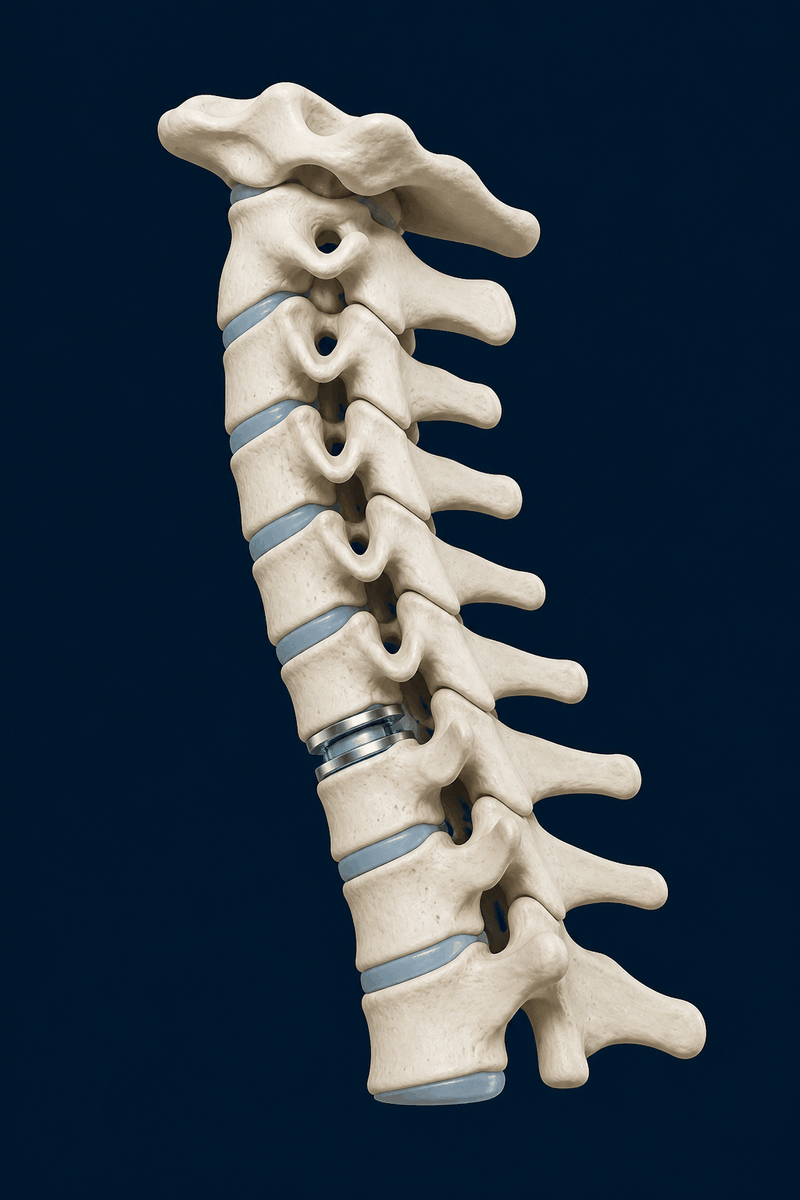
Typical patterns per published FDA study data — the right choice is anatomy-specific and made from your imaging. Ask which fits yours →
What to Expect
The procedure is performed through the front of the neck, an anterior approach that gives direct access to the disc space while gently moving muscle and tissue aside rather than cutting through it.
Once the damaged disc is removed, an artificial disc implant sized specifically to your disc space is put in its place, restoring disc height and preserving the segment's ability to move.
Patients undergoing disc replacement typically have a short hospital stay, and recovery follows a structured, gradual return to activity guided by Dr. Gerlach and his team based on how you're progressing.
Frequently Asked Questions
Disc replacement or fusion — which is right for me?
Both are effective ways to treat a damaged cervical disc, but they work differently: disc replacement preserves motion at the treated level, while fusion offers proven, fixed stabilization. The right choice is specific to your anatomy — alignment, bone quality, and facet joint health all factor in — which is why this is decided after a review of your imaging, not as a one-size-fits-all answer.
How long do artificial disc implants last?
These implants are designed for long-term use. As with any implanted device, Dr. Gerlach and his team monitor how the implant and the surrounding spine are doing at follow-up visits over time.
Am I a candidate for disc replacement?
That requires a review of your imaging — Dr. Gerlach evaluates the alignment of your neck, your bone quality, and the health of your facet joints before recommending it. Disc replacement generally isn't appropriate for patients with significant deformity or spinal instability, where fusion is usually the better fit.